Showing posts with label Poetry. Show all posts

Saturday, January 28, 2012

Serious Poetry/Fun Poetry

I've come to realize that poetry is yet another area in my life where I don't necessarily conform to the mold.  Much current poetry does nothing for me--and what is the point of poetry if not to move you in some way? Still, I think that the trick is to keep looking, keep reading, and sooner or later I'm bound to find more things I love.

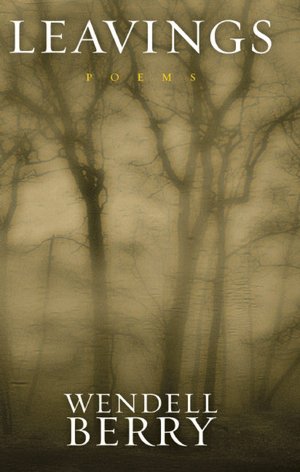
One collection I read last year and never talked much about was Leavings by Wendell Berry.  In general I enjoyed it, although (in this collection at least) much of it tended to be a little too enviro-centric for me.  He does have a way with language, however, that made him easy to appreciate...especially when he talked about life and family.  I look forward to comparing his fiction to his poetry at some point.

Over the Edge

To tell a girl you loved her--my God!--
that was a leap off a cliff, requiring little
sense, sweet as it was. And I have loved 

many girls, women too, who by various fancies 
of my mind have seemed loveable. But only 
with you have I actually tried it: the long labor, 

the selfishness, the self-denial, the children 
and grandchildren, the garden rows planted 
and gathered, the births and deaths of many years. 

We boys, when we were young and romantic 
and ignorant, new to the mystery and the power, 
would wonder late into the night on the cliff’s edge: 

Was this love real? Was it true? And how 
would you know? Well, it was time would tell, 
if you were patient and could spare the time, 

a long time, a lot of trouble, a lot of joy. 
This one begins to look--would you say?--real? 


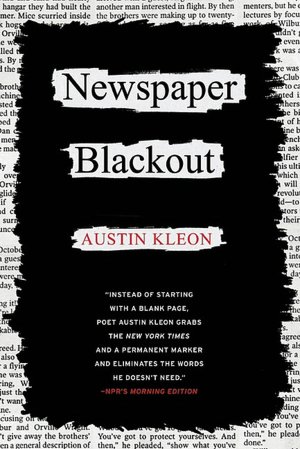
Short poems tend to be my thing, and I'm always up for a bit of humor, so Austin Kleon's Newspaper Blackout has been a fun poetic diversion for me.  This book not only takes you through the story of how he came to create poetry with a black marker, but gives you some pointers on creating your own and gives you some samples of other people's creations as well.  Some are simple, some are funny, all left me wanting to do some myself.
children play to keep sane

The Ninja's Chauffeur

Which would you rather
be
A

kill something ninja
with a family
yr destined to avenge

or
the ninja's
trusty chauffeur.

who is
quiet, hard-working,
and

known to date
a lot
more girls?


Although I enjoyed this collection, I ended up feeling that perhaps I was sold on the idea of these poems more than on the actual poems themselves.  There was a small handful that I loved, but most lacked the punch that a short poem needs.

This is the first collection of poetry I've finished reading this year, and the others I plan to read are also single-author-collections.  I'd like to put an anthology in the queue, though...any suggestions?


Tuesday, June 14, 2011

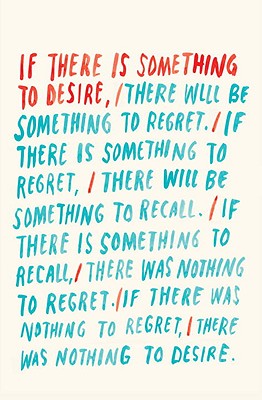
If There is Something to Desire by Vera Pavlova

I have found a poet I love.  Perhaps it was bound to happen sooner or later, considering my determination, but part of me feared that poetry was going to be another of those areas where my tastes are not the norm...that I'd remain the unfulfilled oddball in the corner, wondering what was wrong with me (I like to write poetry, why on earth don't I like to read it?)  Thankfully, it was just a matter of finding the right poet.

Vera Pavlova is a Russian poet whose work is translated by her husband, Steven Seymour.  (As a side note, my Russian friends inform me that Americans always stress the wrong syllable in Russian names...it isn't Pav-LO-va, but PAV-lo-va...maybe someday I'll get it right on the first go round.)  It's refreshing to experience a view of life from a different culture.  The only downside to having a favorite poet who writes in a foreign language is that I am unable to enjoy all that she has written.  If There is Something to Desire is her first full-length volume to be published in English, and I'm crossing my fingers (and hoping) that it won't be the last.

Praised for her succinct directness, I find that her little thoughts are often a combination of heartbreak and whimsy.
Why is the word yes so brief?
It should be
the longest,
the hardest,
so that you could not decide in an instant to say it,
so that upon reflection you could stop
in the middle of saying it.
Somehow she manages to encapsulate so much in so few words, making this volume of 100 small poems highly re-readable.  There were only a handful that really grabbed me at the time of reading, but I have a feeling that I will gain new favorites through the years.  This is a volume that will stay on my shelf only to be pulled down again and again--I love the way she looks at the world.
Basked in the sun,
listened to birds,
licked off raindrops,
and only in flight
the leaf saw the tree
and grasped
what it had been.
Pavlova's poems are easy to appreciate (some more than others) and worth checking out.  I think my favorite of the collection--because I'm a goof and this just tickles my fancy--is this brief statement:
I have brushed my teeth.
This day and I are even.
This is poetry I can love.  A little humor, and somehow a lot of back-story--it sets my imagination rolling!  Light and dark, quick yet lasting.  What do you think of these three poems?  How do they compare to other poetry you may be familiar with?  As always, I'm open to recommendations!  This volume gives me hope of finding other favorites out there...this journey into poetry is becoming much more exciting.

Title: If There is Something to Desire
Author: Vera Pavlova
Pages: 128
Published: 2010 Knopf
My Rating: 4.5 stars

Wednesday, May 11, 2011

Contemplating Success

Defining "success" is not as simple as looking it up in the dictionary.  My dictionary (so hefty it has its own stand) says this:

succeed: to prosper
successful: turning out to be as was hoped for
success: a favorable or satisfactory outcome or result

You see, it's all relative: prosperity, hope, favor, satisfaction.  These are all things that are individually interpreted and personally defined.

I've thought about success before--quite often, actually--but the kicker is that even your own personal definition is likely to be different depending on the context.

As a mother, I base my success on whether I have loved and nurtured to the best of my capability.  As a wife, I feel successful if my husband feels appreciated and valued.  In finances, I think success relates to what you do with what you've been given (not just monetary stewardship, but also time, education, and talent.)

For me, success is intertwined with continued growth and effort.  It is less about the goal than it is about the journey.  Of course, the little bonuses are always nice: a car or house, a happy family, etc. and I'm not discounting those, but there needs to be a balance...you can't base everything on tangible rewards.

One area in which I haven't solidified my opinion of success is in regards to writing.  I love to write--to create in general--but I'm constantly torn between wanting to create for the artistic experience alone, and striving for outside validation.

Ordinary Genius: A Guide for the Poet WithinI was flipping through Ordinary Genius: A Guide for the Poet Within today and ran across this question:
What is your definition of success as a writer?

I had to stop and think about it.  As a writer?  Well, I'd love to be published.  Of course I would.  But that is only one measure of success.  We all know that there is amazing work that remains unpublished, just as well as we know that there is published work that is undeserving.

And there is part of me that feels like I don't want anything less than my best published...and since I'm still growing, still learning, still experimenting with my preferred medium, I may never reach my best.  I waffle...thinking about that goal makes it harder for me to enjoy the journey, makes it easier for that doubt to creep in (the last line from the movie Doubt has been surging through my head lately: Meryl Streep cries, "I have doubts. I have such doubts.")  At which point I force myself to look back and remind myself that it is less about the goal than it is about the journey.

My definition of success as a writer, or as a reader, must be the same as anything else I devote time to: continued growth and joy in the journey.  Perhaps, at some point, the validation and other little bonuses are part of that process...perhaps at some point I am happy enough with my work to seek publication...perhaps at some point I get published.  But perhaps I don't.  And perhaps it is okay to feel successful either way.  

How do you define success in your reading or writing?  Do you work more on tangible goals than I do?  I'd love to hear another perspective--what works for you?
The guide words in my dictionary explain everything:
"succeed" is on the same page as "suck" ...which is why
it is so easy to waffle between the two!

Thursday, April 7, 2011

Book Poetry

Chelle, at The Prairie Library, is celebrating National Poetry Month by hosting a Book Poetry Contest and a Poetry Giveaway.  And, well, I couldn't pass up an opportunity to compose a poem from book titles.  I seem to enjoy writing poetry more than reading poetry...what's with that?  Maybe expressing my creativity is simply an entirely different process than appreciating creativity and I create in a different medium than I appreciate.

Enough with the philosophizing, here's my book poem.  The poem must be composed of entire book titles, and while I may have gone slightly too abstract and apocalyptic for my own good, I like it.

          after the quake,
            things fall apart.


          march a thousand acres
            for the children's sake--
              a voyage long and strange.


          snow.
            the blood of flowers.
              small wonder.


          as I lay dying,
            everything is illuminated.


Saturday, February 5, 2011

Nine Horses by Billy Collins

Nine Horses: PoemsTitle: Nine Horses
Author: Billy Collins
Pages: 144
Published: 2003 Random House (orig. 2002)
My Rating: 3.5 stars

I've done it!  I've made it through my first volume of modern poetry (not counting the children's poetry I read to my kiddos all the time) since this Literary Blog Hop.  Other than Willa Cather's April Twilights, which I read last year to kick off my personal goal to read Cather's published works, this really is the first serious attempt I've made to read grown-up poetry in just about forever.

I was hooked when I read the first poem: Night Letter to the Reader.  I read only a poem or two a day, not wanting to overload myself, but I still found that some of his poems just seemed to be alike.  I may have enjoyed it more if I had rotated with another poet, but I was a little afraid that if I did that, I wouldn't commit to finishing any one volume.

I was interested to find that, (like I mentioned on my Blog Hop post,) it was still the shorter poems that I enjoyed more.  There is just something about how condensed the thought becomes when it is fitted into few words that feels magical to me.  I loved this one:

No Time
In a rush this weekday morning,
I tap the horn as I speed past the cemetery
where my parents are buried
side by side under a smooth slab of granite.

Then, all day long, I think of him rising up
to give me that look
of knowing disapproval
while my mother calmly tells him to lie back down.
Leavings: PoemsI still find myself waffling between loving poetry and not connecting with it.  However, I'm now at the point where it seems to be more a matter of finding the right poet, or the right poems from the right poets, than a like or dislike of poetry on the whole. There seems to be such a wide variety in poetic style, that sometimes I wonder how it all fits together.  How do I go about finding my niche?

If There is Something to Desire: One Hundred PoemsSometimes I feel like if the poem is understandable then it can't truly be poetry--meaning, of course, that all the poems I like are of lesser quality somehow--although that's an obvious misconception.  I simply encounter much more poetry I don't like than that I do like, and I haven't yet figured out if that is due to a poetry-immaturity on my part or a stylistic preference, or a combination of the two.  What do you think?  Do I just keep looking and plugging away at different poets and see what happens?  I'm currently working through Leavings by Wendell Berry, and haven't decided where to go next.  I'm considering  If There is Something to Desire by Vera Pavlova because the poems look short and sweet.  How do you keep up on newly published poetry?  Thoughts and advice are welcome!

Tuesday, January 25, 2011

The Lover's Dictionary by David Levithan

The Lover's Dictionary: A NovelTitle: The Lover's Dictionary
Author: David Levithan
Pages: 224
Published: 2011 Farrar, Straus and Giroux
My Rating: 5 stars

Technically I should be reviewing other books before getting to this one...I'm usually pretty good about reviewing books in the order I read them. (And with that sentence I've declared to the world one of my obsessive-compulsive-personality-trait idiosyncrasies.  Oh well, you probably already assumed as much.)  I couldn't wait to talk about this one though. I want everyone to get their hands on it so we can chat about it!

Reading this small description was all it took to make me know I needed to get my hands on this book:
A sweet and modern love story, told through dictionary entries.
Dictionary entries?  Really? Amazing!  And the book is amazing.  It's addictive, actually.  The entries aren't long, they range from a sentence or two to just over a page.  Due to that, as well as the thoughtfulness and humor that is laced through each definition, this book reads almost more like a collection of prose poetry than a novel.  But a collection that you can't stop reading.  There isn't the traditional story arc or dialogue found in most novels, but what is contained between "aberrant" and "zenith" is so absorbing, fun, and honest that traditional isn't at all missed.
stanchion, n.
I don't want to be the strong one, but I don't want to be the weak one, either.  Why does it feel like it's always one or the other?  When we embrace, one of us is always holding the other a little tighter.
I found it to be a little sad at times, but there were so many things I identified with that I couldn't help but be charmed.  What relationship has not experienced uncertainty, fascination, irritation?  This is a book worth owning, and not simply because you will want to show it to every person who walks through your door.  This is a book you will see on your shelf and pull it down to read an entry or two, just to get a taste of that full-to-bursting feeling that goes hand in hand with falling in love.
aloof, adj.
It has always been my habit, ever since junior high school, to ask that question:
"What are you thinking?"
It is always an act of desperation, and I keep on asking, even though I know it will never work the way I want it to.

Monday, December 6, 2010

Night Letter to the Reader

Thanks to you, my literary friends, and the fabulous group at The Blue Bookcase, my horizons are expanding.

I love that feeling.  I love branching out, the wonder of voluntarily being forced into new experiences.

Before this last weekend was over I had ordered two books of poetry: Billy Collins and Wendell Barry. One small poem from each of these I read, and knew I needed to read more.  Wendell Barry had this simple thought expressed in few words:
Leavings: Poems
LIKE SNOW 

Suppose we did our work
like the snow, quietly, quietly
leaving nothing out.


I love that!  I haven't received the book yet, so that's all I've experienced so far (via the handy dandy Amazon preview) but I'm looking forward to reading more.  I did receive Nine Horses by Billy Collins today, however, and fell in love with his intro poem:

NIGHT LETTER TO THE READER
Nine Horses: Poems
I get up from the tangled bed and go outside,
a bird leaving its nest,
a snail taking a holiday from its shell,

but only to stand on the lawn,
an ordinary insomniac
amid the growth systems of garden and woods.

If I were younger, I might be thinking
about something I heard at a party,
about an unusual car,

or the press of Saturday night,
but as it is, I am simply conscious,
an animal in pajamas,

sensing only the pale humidity
of the night and the slight zephyrs
that stir the tops of the trees.

The dog has followed me out
and stands a little ahead,
her nose lifted as if she were inhaling

the tall white flowers,
visible tonight in the darkened garden,
and there was something else I wanted to tell you,

something about the warm orange light
in the windows of the house,
but now I'm wondering if you are even listening

and why I bother to tell you these things
that will never make a difference,
flecks of ash, tiny chops of ice.

But this is all I want to do--
tell you that up in the woods
a few night birds were calling,

the grass was cold and wet on my bare feet,
and that at one point, the moon,
looking like the top of Shakespeare's

famous forehead,
appeared, quite unexpectedly,
illuminating a band of moving clouds.


Ah!  Is this what poetry is all about?  Here I've been, missing out on something fabulous.  These guys know how to express a thought, don't they?

Wednesday, December 1, 2010

I'm a Poet and I Just Know That I Am

poetry?  I'm so torn about poetry.  I love poetic prose, but often poetry itself does nothing for me.  I can't say I dislike it (although I know many people who do say that) because I'm often inspired to write it.  Not very well, I'm sure.  But still.

Oh, and the length.  Once poems stretch beyond a couple of dozen lines I drift off and lose concentration.  Somehow, when reading a novel I have great focus and introspection, but in poems I much prefer something that doesn't need dissecting.  Something with wit.  These are the kind of poems I write:

Haiku for the Errant Turn Signal
Ever blinking light
Falsely suggesting intent
Unaware driver

coffee
caffeine
opening eyes
freshly ground
flaming hot
energy burst
everything is beautiful

bored
Expectations, unreasonable, unseasonable
Balking, pouting, sore.
Excursions, endurable, interminable
Waiting, sitting, bored.

So, would it make sense to say that I love the poetry of language, but don't love the language of poetry?  

I feel like I'm reading poetry all the time, yet I don't know that I have a favorite.  They just don't stick in my head like full-length works.  I did love this one, though, by Willa Cather (in her only published collection of poetry) titled L'ENVOI

Where are the loves that we had loved before
When once we are alone, and shut the door?
No matter whose the arms that held me fast,
The arms of Darkness hold me at the last.
No matter down what primrose path I tend,
I kiss the lips of Silence in the end.
No matter on what heart I found delight,
I come again unto the breast of Night.
No matter when or how love did befall,
'Tis Loneliness that loves me best of all,
And in the end she claims me, and I know
That she will stay, though all the rest may go.
No matter whose the eyes that I would keep
Near in the dark, 'tis in the eyes of Sleep
That I must look and look forever more,
When once I am alone, and shut the door.

But see how it's all depressing?  Where are the witty poets? Not funny, slapstick, silly, har-har stuff...I want something clever, like Bite Size Jane Austen.  That's what I want.  Any suggestions for me?

(Thanks to The Blue Bookcase for supplying great topics for literary conversation!)

Wednesday, November 17, 2010

Tinkers by Paul Harding

TinkersTitle: Tinkers
Author: Paul Harding
Pages: 191
Published: 2009 Bellevue Literary Press
Read For: winning the Pulitzer Prize in 2010
My Rating: 4 stars

Now here's a book to be read for it's love of language.  If you enjoy poetic prose, this small lyrical novel is a breathtaking example.  If, however, you have been looking for a good synopsis of the story to determine whether you are interested, you might find yourself coming up short because there is no straightforward plot line.  This (from the back cover) is actually a pretty good explanation of what you'll find in between these small white covers.
And old man lies dying.  As time collapses into memory, he travels deep into his past where he is reunited with his father and relives the wonder and pain of his impoverished New England youth.  At once heartbreaking and life affirming, Tinkers is an elegiac meditation on love, loss, and the fierce beauty of nature.
It is the story of George, who is dying, although the focus is more on his father, Howard, who suffers from epilepsy.  We get bits of George's life and his childhood experiences; whatever happens to flit around or linger in George's final thoughts.  There are bits included on horology (the art/science of making timepieces) that lay a lovely comparison for the way the lives of fathers and sons are intrinsically connected and entwined.

A description of one of George's hallucinations (eight days before he died) choked me up with its clarity and beauty, and that was only on the second page.  I found myself writing down all kinds of quotes, although looking back on them I've realized that they hold much more beauty in the context of the surrounding observations.  Although the books speaks mostly to the father/son relationship, a brief comment about George's daughters at the end of the book stood out to me as well.  (This sentence, by the way, is a pretty good example of how the storyline is mingled with descriptive tangents, although some of those tangents are longer and more meandering.)
The doorbell rang just as he and his wife and two daughters--Betsy and Claire, the two daughters who now sat at his bedside haggard, pale, exhausted; the daughters he loved and whom he realized would be daddy's little girls as long as he allowed them, which was until the day he died, which was today--were sitting to eat.
If you decide to delve into this little world, do yourself a favor and reserve it for a time when you can focus and immerse yourself in the language.  And be forewarned that this truly is a language lover's delight: prepare to be saturated.


OTHER OPINIONS: (have you reviewed this? leave a link!)
Book Chatter "A tiny novel that packs an emotional punch."
Savidge Reads "Harding’s prose is stunning; there is absolutely no other word for it."
The Bluestocking Society "...the plot meandered...without ever really finding a true direction."
Farm Lane Books "I felt that most of the scenes were over described"
And a great review by Jay Parini makes me think that I just might like Faulkner.

Saturday, October 30, 2010

April Twilights by Willa Cather

April Twilights (Dodo Press)Title: April Twilights
Author: Willa Cather
Pages: 47 (36 poems)
Published: 2008 Dodo Press (originally 1903)
My Rating: 3? I feel unqualified to rate poetry!

Because I've loved everything I've read by Willa Cather, (and secretly because I think she looks like my great grandmother which makes me feel happy and cozy,) I have decided to read all of her published works in chronological order--not including early stories originally published in periodicals.

Her first was April Twilights: a collection of poetry.  This is Willa Cather's only published collection of poetry, although she reissued it in 1923 as April Twilights and Other Poems with 14 new poems, and excluding 13 of the originals (cited here).

Based on the beautiful language in the books I've read (O Pioneers! Song of the Lark, and My Antonia) I was looking forward to reading these poems, although I'm not predisposed to like poetry in general.  Often I find poetry to be just a little too inaccessible to be enjoyable; too much work to be pleasing.  This is not to say that I shy away from it, however.  On the contrary, I seem to always be looking for something that will change my opinion--I do love creative use of language, contemplation and insight, wit and whimsy.

Unfortunately, most of the 36 poems in this collection were, for me, mediocre.  There were a couple that were interesting or touching, but most of them were rather forgettable.  I did see little glimpses of the inspiration that must have fueled Cather's later works, which is one of the great things about reading an author chronologically.  My favorite was the last poem in the collection, by far the most breathtaking, titled L'ENVOI:

Where are the loves that we had loved before
When once we are alone, and shut the door?
No matter whose the arms that held me fast,
The arms of Darkness hold me at the last.
No matter down what primrose path I tend,
I kiss the lips of Silence in the end.
No matter on what heart I found delight,
I come again unto the breast of Night.
No matter when or how love did befall,
'Tis Loneliness that loves me best of all,
And in the end she claims me, and I know
That she will stay, though all the rest may go.
No matter whose the eyes that I would keep
Near in the dark, 'tis in the eyes of Sleep
That I must look and look forever more,
When once I am alone, and shut the door.

That's 1 out of 19 on my Willa Cather journey...next stop The Troll Garden and Other Short Stories.