Showing posts with label 3 stars. Show all posts

Thursday, May 16, 2013

How I Finished Reading Crime and Punishment

Well, I managed to finish it.  

That really is the only lasting impression that I've kept regarding Crime and Punishment.  Kind of sad, considering that the book is actually quite well written & Dostoevsky obviously is familiar with mental anguish.  And considering that I adored War & Peace (the other Russian doorstop that it's super cool to brag about having read.)  Actually I love many 19th century Russian authors...Tolstoy, Pushkin, Turgenev...but Dostoevsky?  Not so much.

What is it, then?  I'll tell you this: I have the same experience when I read Dickens.  Eerily similar experiences, actually.  I think it might have something to do with hope.

Tolstoy, for all his disillusionment with social structures and relationships, seeks purpose and meaning.  Pushkin, though his tales often revolve around a disaster, gives you the sense of noble pride - that all the drama is the essence of life!  Turgenev can seem rather disillusioned and fatalistic, but under it all is the feeling that there is a worthwhile purpose somewhere...if he could just find it.

But Dostoevsky?  No.  Face it, baby, life stinks.  Filth, poverty, wretchedness and debase behavior of all sorts, and then you die.  There might be the occasional angelic spectre, but that's not reality! Nobody can really live like that...because for every innocent being there are dozens of miserable ones greedy enough to steal their joy, and the sooner you come to terms with that, the better off you'll be.

So, maybe it has something to do with hope.  Or maybe it's because I'm not a fan of psychological dramas.  In any case, I had a difficult time getting through this one.  I had the suggested translation by Pevear and Volokhonsky (their translation of Anna Karenina was quite enjoyable) but had the hardest time staying focused.

When I reached the 2/3 point of the book and stalled out, I knew I was in trouble.  I gave up reading Dickens' Our Mutual Friend at the 2/3 point, as well as Irving's Owen Meany.  I have built a miniature track record for not finishing books that I've mostly finished.  I needed to come up with a solution, and quick - before my inaction became a default action.

I went to Audible, figuring that if someone was reading aloud AND I was reading along, it would be much more difficult to let myself get distracted.  After one false start (when I accidentally bought this version instead of the one I actually wanted) I was successful.  It worked.  And let me tell you, the story and the writing were actually pretty interesting after all, when translated by Constance Garnett and read aloud to me.  But what work it took to get me there!

Sigh.  And now, having read both The Eternal Husband and Crime and Punishment, I think I may safely say that it will be quite some time before I feel the need to read more Dostoevsky.  It doesn't bode well for Dickens either.  My apologies to all the fans.

Friday, February 1, 2013

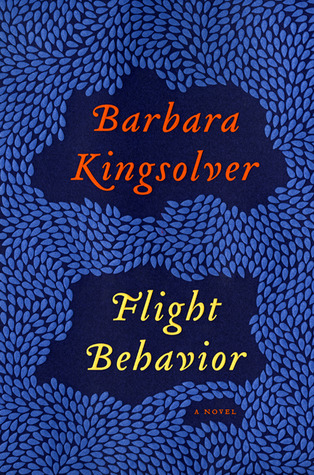
Flight Behavior, or: May I Have an Agenda Please?

Despite my extreme dislike of the Agenda-Novel, I still have traces of conviction that there is a way that it should be done and a way that it should not be done—and most authers reside in the latter.  After reading Persuasion, (a book that argues for love over propriety, and good company over good manners,) and seeing how it should be done, Kingsolver was even more of a let down.  Once an author decides to write a novel instead of a persuasive piece of nonfiction, the characters and the story should have the forefront—not the agenda.

Of course, I'm willing to concede that this could be partly personal opinion.  After all, I know many people love Lord of the Flies, and (though its message was far more integrated into the story than how Kingsolver handled her message) I found it maddeningly like being preached at.

Around midpoint, this book went from being a light engaging read (in the weight of the prose, not in significance or beauty) to being a dragging slog through an environmental primer. It did pick up at the end, but the whole agenda/lecture felt rather insulting.

One of the things that frustrated me no end was the tone Kingsolver used in her arguments...that let-me-explain-this-to-you-in-very-simple-terms tone.  As a reader, I'm stuck giving the author the final word—or so it feels whilst reading—and can't help but feel that, though I'm the frustrated one, she's the one that loses in the end, because this was not an intelligent discussion or an invitation to stimulate thought; this was a lecture.  A lecture that didn't accomplish anything.

In one sentence she  rages that nobody will open their eyes and see what is going on, and in the next she says there is absolutely nothing anyone can do to stop it.  Have you ever watched a documentary hoping to bring awareness to a serious issue, that tells you in the end that there is no solution?  What's the point of that?  OK, we're all aware, so what's next?  Live in hopelessness and despair?  What does that accomplish?

I've always been so impressed with Kingsolver's nuance and subtlety but she let it drop here. I liked the location, even though I never fully felt the setting.  The characters were interesting, and the butterflies were beautiful and amazing.  My final feelings are torn, as I did enjoy the writing, but being talked down to is never a pleasant experience. 3.5 stars for what might have been...though as time goes on I like it less and less.

Tuesday, January 15, 2013

Cashing in on Jane Austen

A year or two back, (whenever it was that Jane Austen was beginning to be extremely supremely in,) a friend and I tossed around the idea of starting a blog dedicated to reading all the knock-off/spin-off (and otherwise Jane Austen inspired) books that were being published like crazy.

And then I began compiling a list.

I stopped somewhere around number 200 (I kid you not) because regardless of whether the books would be quick to read, the project was quickly growing to a size of not funny.

Humor is a funny thing.  (Well, of course it's funny—after all that's the point, isn't it?)  What is funny to me might not be funny to you. For example, you might think that the cover of the book pictured to the left is not funny, but I think it's hilarious.  (Not saying that the story itself should be ridiculed, just that the cover art cracks me up.)

So I dropped the idea of the project (I've got a gazillion other things to do anyhow) but one book stuck in my mind.  Another book with a cover that made me giggle.  And so I put it on my Paperback Swap wishlist, and before long it came.  It's a slim epistolary exchange between two long-time friends, discussing Jane Austen's Pride and Prejudice, and Mansfield Park.

I was hoping to be as entertained throughout the book as I was by the cover, but unfortunately that didn't happen.  It was readable and enjoyable, but both of these guys liked Austen way too much for it to be exceedingly amusing.  (If it was a book about my dad reading Jane Austen, the action would be non-stop, I assure you.)

So this wasn't a huge success for me, but it's actually made me [slightly] curious regarding Regency Era bodice rippers...I think Jane might have gotten a kick out of that one.

Oh, and just in case you are interested in the list, click here to check it out!  Which titles did I miss?

Thursday, August 9, 2012

And the Pulitzer for Adapted Novel Goes To...

Is it just me [all irritated because the Pulitzer board didn't do their job this year] or shouldn't the fiction award go to a completely original work?  Maybe that's just my interpretation of "For distinguished fiction by an American author, preferably dealing with American life." (emphasis mine)

ANYhow, my book club just finished reading a Pulitzer (A Thousand Acres, Jane Smiley - 1992) and my reading-enjoyment kept being compromised by the thought that the storyline wasn't completely original.  It's based (heavily) on Shakespeare's King Lear, (who, in the event you have forgotten, is not American,) both in characters and plot.  Not being all too familiar with King Lear, much of the book (section divisions, character development, plot points, etc.) felt jumpy and forced to me.  As a new perspective on a classic, I'm sure there is much to appreciate, but as a piece of "distinguished fiction by an American author" there was much to be desired.

Despite the oddities present due to the close parallel, the premise was interesting, the writing was easy to digest, and it kept me turning pages.  I had hope at the beginning, when the writing was crisp and unique, that Jane Smiley was a new favorite author.  But I ended up noting only the one passage:
We might as well have had a catechism:
What is a farmer?
A farmer is a man who feeds the world.
What is a farmer's first duty?
To grow more food.
What is a farmer's second duty?
To buy more land.
What are the signs of a good farm?
Clean field, neatly painted buildings, breakfast at six, no debts, no standing water.
How will you know a good farmer when you meet him?
He will not ask you for any favors.
That fun bit aside, this was the least poetic Pulitzer I've ever read.  It was, admittedly, a brilliant look at American farming in the late 1970s, but I was ultimately disappointed.  I would have liked it much more if I wasn't hoping for the quality I've found in other Pulitzer Prize winners.  You've been warned!

Good idea: reading A Thousand Acres as a comparison to King Lear.
Bad idea: reading A Thousand Acres as a comparison to other Pulitzers.

Tuesday, July 31, 2012

On the Road by Jack Kerouac

I've officially done it!  Wallace's read-along for Kerouac's On the Road is complete and I can now say that I Have Read This Book.

I discovered that many of my fuzzy notions about this book were actually sizable misconceptions.  For example, I was rather worried about the rumours of stream-of-consciousness and hard-to-follow writing.  In actuality, Kerouac's writing was one of the things that made this book enjoyable.  I adored this (from page 8) which was just about as "streamy" as it got:

They rushed down the street together, digging everything in the early way they had, which later became so much sadder and perceptive and blank.  But then they danced down the streets like dingledodies, and I shambled after as I've been doing all my life after people who interest me, because the only people for me are the mad ones, the ones who are mad to live, mad to talk, mad to be saved, desirous of everything at the same time, the ones who never yawn or say a commonplace thing, but burn, burn, burn like fabulous yellow roman candles exploding like spiders across the stars and in the middle you see the blue centerlight pop and everybody goes "Awww!"

I loved this description: “His excitement blew out of his eyes in stabs of fiendish light.”

Apart from being a little bit in love with Kerouac himself, I also loved the clear picture of America and Mexico in the late 1940s.  It was like getting a real glimpse of history, rather than a retelling.  Unfortunately, the novelty of traveling and visiting places familiar and strange wore off the more Dean Moriarty (aka Neal Cassidy) was in the picture.  That guy is just a super-stressball (compounded by the fact that I know someone who (in some ways) is very much like him.  So much that I've actually heard the same defense for said person as Kerouac did for Dean:)
I longed to go and put my arm around Dean and say, Now look here, all of you, remember just one thing: this guy has his troubles too, and another thing, he never complains and he's given all of you a damned good time just being himself, and if that isn't enough for you then send him to the firing squad, that's apparently what you're itching to do anyway...
Another misconception I held before reading the book was that it was all only sex&drugs.  Certainly there is a lot of sex&drugs, (one scene in Mexico stands out in my mind,) but for the most part, Kerouac's insights and observations made it apparent that post-WWII America was a little lost and trying to figure out exactly what life was all about.  The problem was the lack of hope.  Seeing a group of people not be able to move on, or grow out of, such behaviors is sad.  Although I appreciated the historical importance, and enjoyed Kerouac's writing, most of this book ended up leaving me somewhat ambivalent.  Dean was stressful, and everyone's inability to be content was depressing.

I am glad I read it though, both for its significance in literature, and because I no longer have those misconceptions I began with.  It was easy to read in many respects, but a growing experience at the same time.  Kerouac had many acute observations, even in the midst of dizzying jazz and exhilarating car rides, that made my time with the book much more enjoyable that it might have been otherwise.  I'll leave you with one I especially liked.
Dean took out other pictures. I realized these were all the snapshots which our children would look at someday with wonder, thinking their parents had lived smooth, well-ordered, stabilized-within-the-photo lives and got up in the morning to walk proudly on the sidewalks of life, never dreaming the raggedy mess and riot of our actual lives, our actual night, the hell of it, the senseless nightmare road. All of it inside endless and beginningless emptiness. Pitiful forms of ignorance.

Saturday, July 7, 2012

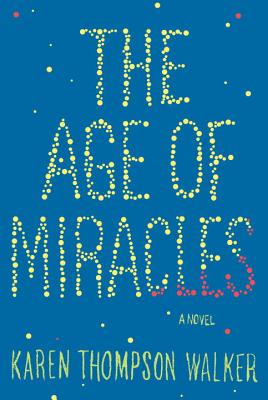
The Age of Miracles by Karen Thompson Walker

Can you believe I'm reviewing a Hot Off The Shelves New Release??  Maybe this occurrence isn't as crazy-rare as it feels, but it does feel to me like this is the first new release I've read in a while (pls excuse my exuberance).

Even if you've had your head buried in the sand (like me) you've likely heard of this book.  Which explains my disappointment when I heard it was going to be featured in the next Indiespensable shipment (ugh, hype and all that jazz.)  Fortunately, those kind folks did an incredible job putting together a fun package - the best one recently - beautiful hardback, purty dust jacket, lovely slipcase, "survival" goodies.  Okay, maybe I wasn't miffed after all.

And now, on with the book, right? The premise is interesting: a California girl and her family try to adjust to the one global calamity they had never considered, as the earth's rotation begins to slow.  Sounds science-fictiony, yet - as my husband declared - The Book Is Way Too Short To Explain Everything...it's really more about the people, how they adjust and react.  Sounds like my sort of thing after all!

There was a lot that I enjoyed about this book.  I found the writing to be enjoyable, the premise piqued my interest throughout the book.  However, there were a lot of little things that bugged me, making this more of an "enjoyable reading experience" rather than a "wonderful book".   Let's bullet-point this:
  • The ages of the kids seemed incompatible with their behavior.  These were 11 year-old kids acting like 14 year-olds (parties & other behavior) and I had to keep reminding myself of their ages. (And before you say that's how it is now and declare me out of touch with reality, keep in mind that I have an 8, 11, 13, and 16 year old and we live Southern California.  I should be able to identify.)
  • As if California didn't already have enough stereotypes...luckily the "We Californians..." sentences began to thin out as the book went on because they were about to ruin the book for me.   Really.  As a native Californian who has felt only 2 real earthquakes and rarely eats outside, I could rant about this for pages.  It's a big, diverse state, making generalities a little silly.
    • "We were Californians and thus accustomed to the motions of the earth. [...] But we Californians were no more prepared for this particular calamity than those who had built their homes on more stable ground." 
    • "This was California--almost everyone had migrated here from someplace else." 
    • "This was California--we ate outside in every season."
  • People's motivations seemed non-existent or unimportant.  Julia didn't seem all too upset when upsetting things happened, and why the "clock-time" people despised the "real-time" people was never really shown.  So, not only did people react differently than I would have thought, but there wasn't any real explanation showing why this might be.
  • Way too many blatant foreshadowing sentences for such a mellow ending.  Tons of "I would learn later" and "We didn't know then" or "It was the last time" sorts of comments that ended up not really pointing to anything in particular.
Despite all those complaints, I really did enjoy reading the book.  I liked that it didn't have a super tidy ending.  I can't help thinking that the hype is do more to the politically-correct timing of the global disaster theme than anything else, but the ease of reading and the interesting story were enough to overshadow the lack of character development and other minor irritations for me.  And besides, it's a treat to look at.  That's got to count for something, right?

Saturday, June 16, 2012

Mary Shelley's Frankenstein

There I was: heading for the couch with purpose, book in hand.  It was time to get some serious reading done.  Mary Shelley's Frankenstein hadn't captured my attention thus far, so I knew I needed to concentrate and focus focus focus.  But wait, perhaps I'd better check my email before diving in?  Five minutes later I was contentedly absorbed...in a game of Plants vs Zombies.

Have I mentioned that I am a master procrastinator?  My responsible side has gotten better at fooling my procrastinatory side (who is in turn trying to fool my responsible side in the first place...at what point does this qualify as a mental problem?) and I finally buckled down and plowed through the rest of  the book.

I liked the story of Frankenstein and the monster he created.  The mystical-science aura reminded me a bit of Jules Verne (that was fun) and there is certainly plenty of food for thought presented.  However, the biographical portion of the introduction was much more interesting to read.  Shelley's super-introspective, emotional, memory-flavored sentences bored me to distraction (as noted above).

Last August I read Shelley's novella, Mathilda and adored it.  I loved how her writing perfectly exuded the emotions she was trying to portray.  Her writing style wasn't necessarily any different in Frankenstein, but it did lack the passion that I felt in Mathilda.  Without the great force of feeling, I found the writing to be too flowery and sentimental for my taste.

Can you believe that I've never watched an adaptation of Frankenstein?  I imagine there must be an assortment to choose from, and I'd like to see how it translates into film.  Any suggestions?


Tuesday, January 24, 2012

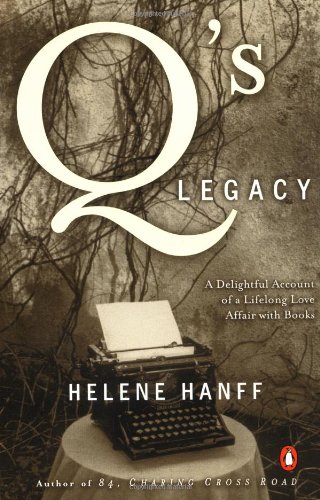
Q's Legacy, Helene Hanff

This book was a beautiful idea--which is actually just a twisted way of saying that I was intrigued by my own misconceptions.  From something I'd read, (helped by the subtitle "A Delightful Account of a Lifelong Love Affair with Books") I was under the impression that I was going to get some details about how Helene Hanff (author of the delightful 84 Charing Cross Road) discovered and learned about literature.  

Alas, that was not to be.  Why must Expectations be such a powerful destroyer/maker of dreams?

What Q's Legacy actually is (which is easily discovered, apparently, by reading the back cover or any synopsis on the web you may happen to run into--who knew?) still has its own charm--never fear.  It is a memoir of her career as a writer, for the most part, dipping into her visits to London as well.

While I deeply wished that she and I had spent this read browsing dusty shelves in old libraries, discovering wonderfully obscure yet extremely useful tidbits of information, Helene is a charming person doing perfectly mundane things as well.  In some ways, this book did nothing to satisfy my curiosity about her; in others, I feared that if I knew more she'd become irritating (sad but true...eccentric personalities are called such for a reason, I'm afraid.)  If you've read 84 Charing Cross Road (and if you haven't, you really should!) and it left you wanting to know more about Helene, then this is a perfectly good place to go next.  In fact, it's part of a trilogy about her life, leaving only The Duchess of Bloomsbury Street (which I haven't read) in between the two.

So maybe I didn't get what I wanted, but that's hardly Helene's fault.  And besides, it knocked a book off my TBR shelf, so who am I to complain?  Have you enjoyed anything by Helene? Please tell me you loved 84 Charing Cross Road...

My favorite quote--from page 97:  
The whole book was so full of outraged capitals that reading it was like being continuously shouted at. When you finished you were just worn out.

Wednesday, October 19, 2011

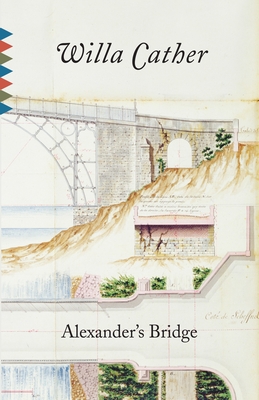
Alexander's Bridge by Willa Cather

With Alexander's Bridge, Willa Cather's published works made another jump in length: from poetry to short stories, and now to a short novel.  In many ways, this short novel contained less of her characteristic insight-into-people-and-places than was displayed in the previously published collection of short stories: The Troll Garden.  It was almost as if this was an exercise at extending the number of pages used, rather than a natural growth of feeling.  At the same time, however, it is still the inner-workings and driving-force of life that command her attention, and thus mine.

It is the story of Bartley Alexander, a renowned engineer and bridge builder, who happens to be one of those people who seems to be kissed by good fortune.  His career is incredibly successful, he marries a rich girl (who he also happens to be in love with), and to top it all off, he gets to travel between Boston and London on a regular basis.  What's not to love?  His somewhat idyllic life begins to unravel, however, when he becomes reacquainted with a former flame.

I was hoping to find something with a little more depth of feeling in it, honestly.  Not that this wasn't an interesting character study, just that it didn't seem to hold Cather's full sense of wonder and heartbreak--as if she was disenchanted with the story: a feeling which rubs off on the reader.  The premise is a good one, I just wish it had been more fully developed.  I'd recommend for someone familiar with Cather in the mood for a novella: sort of Classic Lite.  However, if you are trying to decide which book of hers should be your first, don't start here, as you won't get the proper feeling for her writing.  Instead, find one of the short stories I mentioned in The Troll Garden for a taster, or move into one of her later novels for something with more depth.

(Coming soon: a review of her 4th published work: O Pioneers!)

Title: Alexander's Bridge
Author: Willa Cather
Pages: 144
Published: 2010 Vintage Classics (orig. 1912)
Read for: personal challenge
My Rating: 3.5 stars

Friday, October 7, 2011

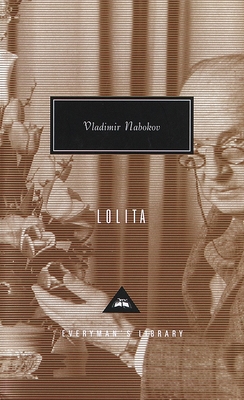
Lolita by Vladamir Nabokov

For a book that started with a paragraph so amazing that it immediately became one of the most brilliant things I'd ever read, Lolita ended up being a very disappointing experience for me.

I knew the basic storyline, (even saw the movie...I think?) Indeed, how could one not know the premise?  It is the prime example of Books Which Are Unceasingly Banned.  The synopsis didn't put me off.  I've been reading long enough to know that it takes more than an unpleasant topic to make a book unenjoyable.  In fact, there have been plenty of books that I've loved despite the topic not being a natural favorite.  Examples: 
 - The Art of Fielding (baseball)
- Revolutionary Road (extreme marital discord)
- Star of the Sea (boats, ocean)
- Slaughterhouse Five (space/science)
- The Good Earth (ancient China)


I was ready for Lolita to fall into a growing line of books in which the writing overcame the topic, but it didn't happen.  Not only that, but it took a great amount of effort for me to finish it.  It was sucking the reading-passion out of me.  Perhaps that sounds drastic and extreme, but, believe me, the going was rough.

By page 70 or so (just after the first incident) I was tempted to quit.  The topic, from Humbert's point of view, was too much for me.  In my mid-book-procrastination, I did what I often do: read reviews of the book online, and read the author's note at the end of the book.  This often helps me refresh my frame of mind and jump back into the book, and it worked this time as well.  The scenes didn't progress as I feared they would, something else happened instead.  I got depressed.

I didn't see any loveliness in this book.  There wasn't any hope, any humor, any levity.  It was all imbalanced minds, selfish passion, and destruction.  Nabokov is a master of language, but he shows H.H. in such a rigidly realistic manner that it didn't do anything for me at all.  The perspective didn't engage me or compel me to contemplate the characters.  It was just sad, depressing, and I wanted it to be over.

I chased Lolita with a cleansing shot of Flannery O'Connor, which seemed to do the trick.  I read the short story "Greenleaf" (part of the collection Everything That Rises Must Converge) last night and enjoyed it greatly--my interest in reading is restored.  Where Nabokov shows unsavory characters in a moderated tone, O'Connor illuminates the ridiculous in us all.  Perhaps it's just a matter of taste, but I'm happy to put this one behind me.  All but the first paragraph, which I still love.
Lolita, light of my life, fire of my loins.  My sin, my soul.  Lo-lee-ta: the tip of the tongue taking a trip of three steps down the palate to tap, at three, on the teeth.  Lo. Lee. Ta.
Title: Lolita
Author: Vladamir Nabokov
Published: 1993 Everyman's Library (orig. 1955)
Read For: Back to the Classics Challenge, Banned Books Week
My Rating: great writing, depressing topic, averages out to 3 stars 

Thursday, September 15, 2011

Blast From the Past with The Forgotten Garden

I've been suffering from reading lag, largely due to my novella challenge.  I read 30 books last month but this month? One.  Finally, one.  I read The Forgotten Garden for one of my book clubs, (although it was already on my shelf from those days when it was the latest thing and I was entranced by the cover anyhow,)  and in a couple of ways it felt like a blast from the past.  (I wanted to wait until my book club met before posting about it, but everyone has been swamped with school, thus the meeting has been put off until next month.  I was already halfway through the book when I found out, and couldn't put off finishing it, so I thought it fitting not to put off posting about it either.)

When I was younger, I loved mysteries.  I loved the way they made me think--those hours at school when I was forced to get my nose out of the book left thoughts swirling through my head and crowding out my teacher's voice.  I've never been so great about actually figuring out the mystery, but that's because the answer isn't what I was after--what thrilled me were the possibilities.  Like so many Christmas gifts under a tree.

I've had intermittent mystery obsessions over the years: a Nancy Drew obsession when I was young developed into a Victoria Holt obsession as a hormonal teen, which then turned into a Mary Higgins Clark obsession as a very young adult.  Since then, not so much.  I've read one Agatha Christie, but that's about it.  So what changed?  Well I grew and discovered literary fiction/non-fiction, and the thrill of a whole new way to get my mind stirred up. The Forgotten Garden, while being a little more refined than the mysteries of my younger days, brought me back there all the same.

Another aspect that brought me back to my youth was the whole premise of the walled garden itself.  I loved Frances Hodgson Burnett when I was young, checking out The Little Princess and The Secret Garden repeatedly from the library.  They were books that stuck with me.  I'm still fascinated by the idea of a walled, overgrown, garden: oh the possibilities!  Kate Morton pays more-than-symbolic-homage to Burnett by actually including her in the book as a visitor to the estate...an inclusion I'm torn about.  In a way it was kind of fun, but it also stood out as being a bit silly.  In a book that did a good job with pace and flow, there were still a couple of things that stood out like that (like the use of "suddenly" at one point, which bugged me more than I thought it would: Suddenly, behind her, a crash.  Not the worst "suddenly" sentence ever, but still.)

The fluctuating timeline worked well for the unveiling of the story, and the characters were all believable, though I prefer more depth.  I enjoyed The Forgotten Garden; found it to be an above average read, but I'm not necessarily rushing out to find her other books.  Have you read The House at Riverton or The Distant Hours?  What did you think?

Title: The Forgotten Garden
Author: Kate Morton
Pages: 552
Published: 2010 Washington Square Press (orig. 2008)
Read For: Book Club (& books on my shelf for 1 year +)
My Rating: 3.5 stars

Monday, September 12, 2011

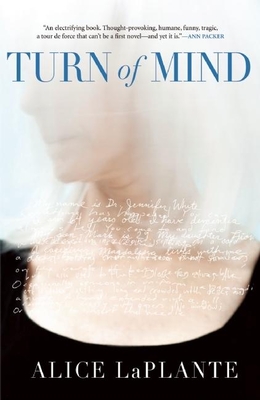
Turn of Mind by Alice LaPlante

Most of us know, whether from our own experiences or not, what Alzheimer's symptoms look like.  But what does it feel like?  This is the thought that Alice LaPlante expands upon in Turn of Mind.  The main character, Dr. Jennifer White, was a newly widowed and newly retired orthopedic surgeon.  Her strong personality stands in stark contrast to the beginning stages of dementia.

The Plot (from the book jacket):
"As the story opens, Jennifer's life-long friend and neighbor, Amanda, has been killed, and four fingers surgically removed.  Dr. White is the prime suspect in the murder and she herself doesn't know if she did it or not.  Narrated in her voice, fractured and eloquent, a picture emerges of the surprisingly intimate, complex alliance between this pair--two proud, forceful women who were at times each other's most formidable adversaries."

The story is split into three different sections, and with each progression the disease progresses as well, indicated by a change in point-of-view.  What begins in first person narrative eventually moves to the second and third person, showing the growing disassociation in Jennifer's mind.  Told in a combination of dialogue, thoughts, journal entries, memories, and general scene description, the big question is: was this combination of techniques successful?  The answer, for me, is yes and no.

I liked the pace of the book--the snatches of conversation, glimpses of the past, and the perceived reality, but other things seemed too fabricated and pulled me away from the story being told.  The point of view, for example, was a little wonky.  It wasn't simply first person, second person and third person, because scenes were often described clearly, when Jennifer definitely wasn't experiencing them that way.  It was more like a first-person-limited-omniscient or something.

It was an enjoyable read, something different and unique, yet still forgettable.  Perhaps because of the distance created from the premise of the story, most of the conflict seemed superficial.  I didn't sympathize with any of the characters, and in fact found most of them to be annoying--especially the view on marriage which was a first-rate downer.  I need hopeful circumspection mixed in with my depressing reality.
You learn, you grieve, you forgive, or at least you accept.  That's why we've lasted.  That's how we've endured.  The secret of a happy marriage: not honesty, not forgiveness, but acceptance that is a kind of respect for the other's right to make mistakes.  Or rather, the right to make choices.  Choices you can't be sorry for, because they were the right ones.  So I never apologized.  And so the matter died between us, but with it something else.  Not enough to bring down the tree of our marriage, but a bough did fall that didn't grow back.
Title: Turn of Mind
Author: Alice LaPlante
Pages: 304
Published: Grove Press 2011
Read For: Powell's Indiespensable selection
My Rating: 3.5 stars
Eligible to be nominated!

Thursday, July 14, 2011

Hotel Angeline: A Novel in 36 Voices

I love the concept here:  instead of bringing 36 local authors together to do a series of readings, how about bringing them together to do a series of writings?  That's exactly what Seattle7Writers and Open Road Media did last fall: a week long marathon of writing live on stage.  Not only that, but the outcome is one quirky, action packed novel--not separate stories or essays, but a single, fabulous, cohesive story.
The story centers around 14 year-old Alexis and her home, the Hotel Angeline, which she is desperately attempting to save.  Hotel Angeline is a resident hotel (and former mortuary) filled with some of the most bizarre tenants imaginable, and was managed by Alexis and her mother until her mother suddenly passed away and Alexis is left trying to figure out how to hold her life together on her own.  The story is engaging, with enough action to keep the pages turning.  The different authorial voices didn't disrupt the story being told, although the multitudinous plot turns did start to wear on me slightly--I guess I'm used to more contemplative stories?  This book seemed to be more about collaboration, community, and story telling than it is about character development or plausibility.

The special part about this is how all of these authors were willing to work together, putting aside their writing quirks--turning a typically isolated exercise into a social, community-wide event.  (Check out the video below to see the authors speak for themselves on the matter.)  I didn't recognize many of the writers, but I loved the experience of being exposed to so many new authors in such a fun way.  


Title: Hotel Angeline
Author: 36 of them! Including Jamie Ford and Erik Larson
Pages: 260
Published: Open Road Media, 2011
Read For: Review, thanks to Open Road and NetGalley for providing my copy!
My Rating: 3.5 stars

Wednesday, June 22, 2011

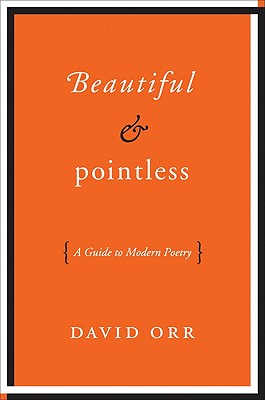
Beautiful & Pointless by David Orr

So, I've been on a poetry quest this year, right?  I've been reading it, writing it, and generally trying to figure it out.  So when I was browsing my local Barnes & Noble (on the day that I bought my new Nook)  I made sure to pick over the poetry shelves (which, by the way, are farther off the beaten path than Alaska).  On the highest shelf of the farthest wall on the lowest level of the bookstore, I saw the spine of this pretty orange book smiling at me.  It looked like it needed a home, and my impulse-book-buying-urges were in Full Justification Mode.

What I Hoped This Book Would Be:
I've struggled with modern poetry largely because, as the title of this book affirms, many of the poems I read feel pointless.  I don't know about you, but if I'm reading something and I'm thinking What's the POINT?? then I generally don't feel like it was a worthwhile read.  This book: A Guide to Modern Poetry, looked to be just the thing to explain to me how modern poetry has evolved, and what on earth I'm missing.  I want to know why "good poetry" is considered good, and why it is so difficult to find different styles of modern poetry.

In many ways, the book was exactly what I was looking for and did what I hoped it would do.  It answered many of my questions and went far to clarifying the current poetry climate.  Also worth mentioning is the fact that it was written in an easy to read, humorous, and intelligent manner.  On the other hand, I was disheartened and disappointed by what I found.  It actually left me rather depressed, and though a good dose of reality isn't necessarily a bad thing, I'm still left wondering if the opinion of this NYTimes Poetry Critic is universal.  If it is, then modern American poetry is in a sad state indeed.

The Good Stuff:
Not of great use for learning how to analyze modern poetry,  but still rather helpful in understanding what modern poetry is, and how it got there.  Among other things, reading poetry is a journey towards understanding how a specific poet thinks and views the world.  In this sense, biographical information about the author may end up being a valuable commodity, depending on the specific writing style.  I liked that the author pointed out that there are some poems/poets that nobody really understands. What this means is that if you don't understand a poem, it isn't necessarily your fault.  Perhaps the poem is appreciated for reasons other than appeal.  Don't discount your gut reaction.  The chapter on Form ended up being a great explanation about the fluidity of poetry rules.

The Sad Stuff:
It turns out that, in the author's world at least, all poets are liberal, political, and non-religious.  Not only that, but it is far too easy to obtain a MFA these days, and the Golden Days of Poets-With-Ambition are long gone. Orr spoke often of the inner politics of poetic elite, at once bemoaning and defending immature and/or illogical behavior.  As far as why "good poetry" is considered good, this portion of the chapter Ambition was telling:
Many of us in the American poetry world have a habit of exalting foreign writers while turning them into cartoons.  [...]  How else, really, to explain the reverse condescension that allows us to applaud pompous nonsense in the work of a Polish poet that would be rightly skewered if it came from an American?
That, to me, shows a couple of things.  First, there really are no absolutes in quality of poetry--beauty is in the eye of the beholder.  Second, being a successful American poet has more to do with politics and popularity than anything else...explaining why it is often difficult to find variety in currently publish poetry.

The Verdict:
Half of this book was fabulously informative and the other half was irritatingly depressing.  If I could turn back time, I'd read every other chapter: The Personal, Form, and The Fishbowl, (skipping The Political, Ambition, and Why Bother?)  That way I'd be able to remain pleasantly content in my optimism and new found knowledge.  Taken all together, there was an amazing amount of reading-between-the-lines, which (while being a fascinating thing to observe and digest) was ultimately very off-putting.  To say that it tempered my enthusiasm for modern poetry would be an understatement.

[edited to add another quote]
      Much as the growth of trees is affected by the quality of the soil, the writing we call poetry is affected by the methods we've developed to produce, distribute, and discuss it.
      In many ways, this is obvious.  Consider, for instance, publishing and reviewing.  The structure of the poetry world helps determine which books end up in print, which in turn determines what poems audiences have the opportunity to hear about and read, which in turn determines what the average, educated person believes to be "poetry", which in turn has an effect on how many poets feel about their own work.

Title: Beautiful & Pointless
Author: David Orr
Pages: 224
Published: 2011 Harper
My Rating: all said and done, I guess this one balances out at a 3

Sunday, May 15, 2011

Sunday Salon: A Bouquet of Mini-Reviews

All the issues that Blogger had this week took the wind out of my blogging sails.  I have so many books to talk about, but I'm not so interested in pouring my thoughts into to a randomly flushing toilet.  I think I'm over it now, however, and thought it might be a good time to do some mini-reviews.  There are some books that I've read this year and just don't have a lot to say about, for whatever reason, but I still want to mention them.  Sounds like much more fun than cleaning out the garage, which is what I'm onto next!  

FlippedFlipped, Wendelin Van Draanen   (...this book has also been made into a movie...)  I heard about Flipped from one of my only book-loving friends.  It sounded like a nice little detour--(life has been so crazy this year that shorter books have been a mainstay in my literary diet)--something out of the ordinary.  And it was: short and sweet.  It is a rather innocent YA title that does the POV switch every chapter (one chapter is from his POV, the next is from hers).  What I liked is how it dealt with crushes, peer pressure, stereotypes and prejudice without being too gritty or age-inappropriate.  This is a title that I'll keep around for my girls to read.
Expiration DateExpiration Date, Sherril Jaffe  (...a LibraryThing Early Reviewer book...)  I was looking forward to reading Expiration Date because of the publisher.  I've become very interested in small press this year, and The Permanent Press is one that I had my eye on.  I'd previously read another of their books, and liked how different it was from mainstream Lit.  Both books however, in addition to sharing a uniqueness, also shared a very rough, unfinished feel.  They felt more like a first or second draft than a copy about to be published.  Expiration Date explores the idea of whether we'd live our lives differently if we knew when we were going to die...although the story ends up focusing less on this idea and more on the life and personality of the main character's mother.  I think it was supposed to be humorous, but it ended up just feeling tedious to me.  A good premise that fell flat.

The Hunger GamesThe Hunger Games, Suzanne Collins  (...read for one of my Book Clubs...)  I don't have a lot to say about this book because it has all been said already, has it not?  Apart from the disturbing premise, I enjoyed it a lot.  Good character development, plot, etc.  But I just couldn't stop thinking about the horrible idea that everything was based on.  I'm glad I read it because I love knowing what the buzz is all about, but I'm not a series girl so I won't be reading the rest.  My kids haven't really expressed an interest in reading it, which I find strange, but I'll keep it around in case they get the urge.

The Tapestry of LoveThe Tapestry of Love, Rosy Thornton  (...a review copy was sent to me by the author--thank you, Rosy!)  To be honest, I was initially worried that this book would be too heavy on the romance for my taste, but it turned out to be pretty balanced.  I couldn't help being reminded of Under the Tuscan Sun, (although I've only seen the movie, haven't read the book) which is pretty inevitable considering that it is about a woman in a new phase of life that decides to move out of the country and become part of a small, foreign community.  In this case, a woman moves from England to France, and decides to start a tapestry/furnishing service in a small mountain community.  At times it was a bit too detailed, but I enjoyed experiencing the discovery of a new place and new people.  I can't help but be fascinated by the idea of relocating somewhere far away.  Although I'm not too familiar with the French countryside, reading this book felt like I was there...except without the amazing food and drink.  [pout]

If I StayIf I Stay, Gayle Forman  (...given to me by my 10 year old daughter for Mother's Day--what a sweetie!)  While I'm not a huge fan of YA fiction, I'm not opposed to reading it either.  Especially since reading Speak, (Laurie Halse Anderson) because I have a hope to hold onto that I'll find another YA book that manages to be everything it should be: gripping, realistic, well written, and not too irreverent in language/content.  If I Stay did pretty good at these things.  It was gripping, it felt fairly realistic, the writing was average, language/content was a tad more than it needed to be in my opinion...only because those are the parts that didn't feel realistic. The storyline was fascinating, and pulled me straight through to the end of the book: If you were in a coma and had to decided whether to stay with the friends/family who remain, or go with those who didn't make it, how would you decide?  The characters, if not fully developed, were at least unique people.  All in all it was a book I didn't want to put down until I'd read the last page.

Wednesday, April 13, 2011

The Fates Will Find Their Way by Hannah Pittard

The Fates Will Find Their Way: A NovelTypically I'm pretty sure within a minute or two of closing the covers of a book what I thought about it and why...and typically my opinion doesn't change.  This book was different.  I thought I'd let this book simmer for a couple of days before writing my review, but a couple of days turned into a couple of months, and I'm still not entirely settled in my thoughts about it.

Partly at fault was myself--for coming into the book with expectations.  You know how that goes: you highly anticipate something, making it that much harder for it to live up to your ideals.  In this case, my high hopes were focused on Powell's and their Indiespensable program, since this was my first installment.  I was so excited to have found a program that would pick out and send me new, independent, literary fiction without me having to do a single thing (apart from presenting my credit card number) that I simply couldn't wait to dive in.  Also, the cover art is gorgeous.  If it had been a photo of the back of some girl, my expectations would have been sufficiently lowered.

Apart from expectations lies the simple fact that there were things I really appreciated about this book and things I found rather unimpressive.  I couldn't identify with any of the characters (a group of horny high school boys who didn't mature much as they aged) and thought the premise was a stretch.  What group of boys shares a lifelong obsession--fantasies and all--about a girl that disappeared during high school?

However, I did enjoy the writing.  It was written mostly in 1st person plural ("we") which was a fun change of pace, and had a very loose chronology, weaving the past in with different points in the future--both real and imagined.  The writing style actually reflected the mental state of the guys who were still trying to come to terms with their classmate's disappearance decades later.  This might drive some people crazy, but I thought that it was a lot of fun.

Ultimately, this book left me still excited about future Indiespensable shipments...just a more normal-person-excited-in-moderation type of excitement rather than the escalating fervor I'd reached previously.  It also left me thinking about my own high school experience...in some ways so tame and normal by comparison, in other ways tinged with a similar sadness.  This is a book that I won't forget, and that definitely says something.

Title: The Fates Will Find Their Way
Author: Hannah Pittard
Pages: 256
Published: 2011 Ecco
Read For: my first Indiespensable book!  &  my Published in the Current Year Challenge

Tuesday, April 12, 2011

Wench by Dolen Perkins-Valdez

Wench: A Novel (P.S.)Are you still enjoying the last vestiges of winter? Or is it time for some of those summer reads yet?  A book that grabs you and won't let go?  Something that doesn't require huge concentration and does some of the work for you?  Wench, for me, felt like a summer read in that sense.

That is not to say that the subject matter is light and fluffy, for it is anything but.  In this book we peek into the lives of four slave women who are their masters' mistresses in the mid-1850s.  Their experiences--thoughts, feelings, hopes--are all vastly different from each other, but they are united by their shared sense of injustice and the complexity of their situations.

It wasn't so much that individual portions of the book were emotionally difficult to digest (although there were a couple of parts that were somewhat rough) but rather the fact that they kept happening and kept happening.  Which I suppose is one of the points the author was trying to make.  Some slave owners were kind, and some slaves really weren't mistreated horribly, but regardless of the degree of horror in circumstance, one of the really horrid things about slavery is that it is ongoing.  Forever.  With no real hope in sight.

Considering the heavy subject matter, Wench still managed to feel like a light read to me.  I was reading to find out what was going to happen, rather than to stop and ponder the situation...which is interesting because there were definitely enough things to stop and consider.  The story really seemed to flow until it ended quite abruptly, with the last couple of paragraphs becoming all poetic.  I don't think it was a book that absolutely hinged on the ending, though, so the last page was forgivable.  The fact that it was inspired by an actual resort made it all the more interesting.  While not necessarily a favorite, it was an above average read.

Title: Wench
Author: Dolen Perkins-Valdez
Pages: 304
Published: 2011 Harper Collins (orig. 2009)
My Rating: 3.5 stars

Sunday, March 6, 2011

The Sunday Salon: (My First!) & The Slippery Art of Book Reviewing

I love reading The Sunday Salon posts, they are often so relaxing and offer a glimpse of life behind the curtain of book reviews and stat-tracking.  I tried to convince myself that it was not the best use of my time to begin a new project one week before my vacation, when there are so many other things needing to be done, but I didn't listen.  Spending some time sipping tea, surrounded by books, and putting everything into perspective sounds like the perfect way to spend part of my Sunday.

I started my book blog at the end of 2008 as a way to track my reading life without inundating my family blog, but I didn't really join the book blogging community until last June.  As you all know, this is one fabulous group of people, and the time I spend blogging and visiting remains a rewarding addition to my life.  In the 9 months or so since I decided to put more effort into my blog, my blogging style has gone (and continues to go) through changes.  Sometimes these changes are spurred by an imbalance somewhere--type and quantity of reading, type and quantity of blog posts--but sometimes they are spurred by something I've read in a book or on a blog, something that makes me consider what I'm doing from a different angle.

The Slippery Art of Book ReviewingReviewing books in a blog format, just for the joy of sharing bookish thoughts and starting bookish conversations, is different than writing book reviews in a less personal way, as a means to building a career in the industry.  Depending on your style, involvement, and platform, this may be a fine line...but I think it is one worth exploring.  Reading The Slippery Art of Book Reviewing (a title which bugs me every time I think it, say it, type it, read it, type it...what is slippery?  books aren't slippery, nor are reviews, nor even [most] art.  I don't like the idea of slippery-ness. What are we sliding into? Away from? Ugh.) has made me reconsider again, my approach to writing book reviews.

In the past I think I've tended towards maintaining a professionalism in my reviews, striving for nicely constructed sentences and fulfilling prose, often sacrificing strong opinions, humor or passion in the process. The [er...] Art of Book Reviewing has helped me to realize that I am not interested in making a career of book reviewing.  I want to read what I choose to read, and I want to be able to chat about it.  Why it took me so long to realize this, or why it was a fairly simple book that brought me to the realization, I have no idea.  I liked that the book showed that writing short reviews or long reviews is a matter of taste, on the part of the one reading it, the one writing it, and the one publishing it.  I prefer shorter reviews, and have occasionally felt inferior because of it--no more!!

This book also touches on book blogging, and includes resources for becoming more involved in book reviewing professionally, both things I appreciated.  If you are interested in some of the how's and why's behind book reviews, this book is worth a read.  Maybe you'll even get lucky like me and come away with a bit of perspective as well.  Is it ironic that the post in which I talk about my preference for short reviews happens to be a post of some length?

The week ahead, my last week home before my Ireland trip, (a place I've wanted to visit for such a long time,) is all about organization.  My thoughts, my house, my suitcase, etc.  I'm hoping to be able too continue to spend some time here in the off moments, but I'm trying to come to terms with the fact that my time and internet will be limited.  It's reassuring to know that when April rolls around, and my life resumes some semblance of normality for a while, you will all still be around, ready to talk books.  Here's to a productive week!

Title: The Slippery Art of Book Reviewing
Author: Mayra Calvani and Anne K. Edwards
Pages: 186
Published: 2008 Twilight Times Books
My Rating: 3 stars