Wednesday, August 31, 2011

Giving a Hated High School Read a Second Chance

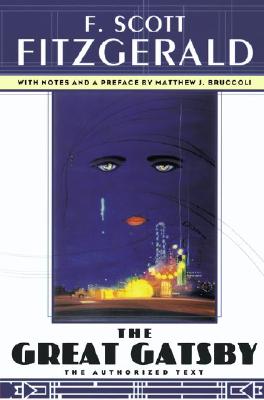
Creepy eyes.  I get it--I think--but I
don't like it.
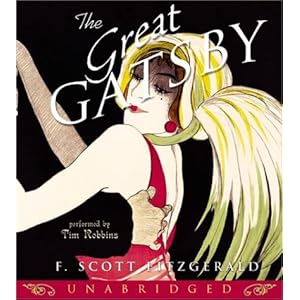
The Great Gatsby.  In high school we had to read this book, and while I didn't actually hate it, I was highly irritated that my teacher was swooning over something that, to me, was depressing and didn't have a point.  And I really dislike the traditional cover, which means more to me than I often care to admit.  I prefer something that gives a better sense of the time...which is why, when I saw the audio-book version had a much more pleasant illustration, I was much more willing to give the book another go (also, being read by Tim Robbins was a great selling point).

And so I bought it.  And so it sat on my shelf for years.  Despite my grand intentions of developing my audio-book skills, the reality is that I'm very rarely alone for any substantial amount of time.  I've homeschooled at least some of my kiddos for the past four years--and those little people can talk.  But a small miracle occurred this week: I was in the car by myself for a whole 7 hours or so while we drove from Southern California to Northern California.  Understand that this is a good thing: an island of bliss amid an ever-present sea of conversation.
Now that's a cover I can love.
Can't you hear the jazz?

It was brilliant.  This book that I always thought had no point said so much.  This book that I was convinced lacked hope had wisdom mixed in with the heartbreak.  The writing was beautiful (though not so sure about that chapter-length list of names) and Robbins was a great narrator (for the most part--the girls' voices were a little odd, but the men's voices had so much character that overall it was wonderful).  There were parts that I wished I could stop and re-read and ponder, but it's hard to do that when you're driving and listening.  :)

I hadn't planned on getting to this book this year, but am glad the opportunity arose.  (I'm totally using it as one of my Back to the Classics Challenge books too!)  Have you read (or reread) Gatsby?  Did you like it?  And what about those covers?  I'm on the hunt now for a nice print copy of this book.  Nice cover is a must.  When I get back to SoCal I'm heading over to my local bookshop: Gatsby Books.  They're bound to have a copy or two, right?

Sunday, August 28, 2011

Officially Calling it Quits

Throwing in the towel, waving the white flag of surrender, kaput, finis, done.  No more novellas for me.

I know...there are four days left of the month: prime reading time!  But my brain is saturated with classic writing and I'm subconsciously digging in my heels.  I want to read something simpler, more lyrical, new and fresh.

I want to read something that is not next in the stack.

So...even though there are all kinds of interesting novellas still waiting to be read...they are simply going to have to wait a little while.  I may read them intermittently through the next few months; it's just as possible I may wait until next summer to finish them up.

A Final Look: left=read, right=unread
What I've learned:
  • There are oh-so-many classic authors that are delightful to read. I've found many authors that I'm exited about, and thrilled to have exposure to so many more than I did less than a month ago.
  • Russian authors feel SO much older than their American contemporaries.  Makes sense, I guess, but still...wow.
  • My dislike for the ocean is a bit more than a preference after all.  Turns out it has the power to make words swim on the page and thoughts swirl in my head.
  • I CAN read intentionally--purposefully--and enjoy it.  My TBR shelves are no longer as intimidating as they once were.
  • I needn't be afraid of Dostoevsky.  Or anyone else for that matter.  An author's writing may not be to my taste, or the right fit for the time in my life, but that's okay because there are others who are.  I just need to stick with them.
  • Reading 28 books in a month is totally do-able.  Classic outweighs short length, right?

What's next:
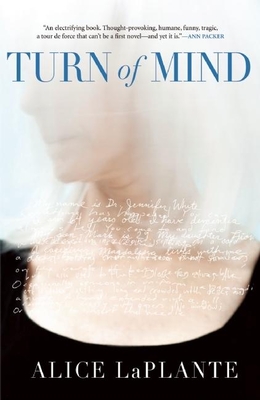
First up is Turn of Mind by Alice LaPlante.  This was the most recent Indispensable book, and the first page has me hooked.  There are a lot of others that I'm looking forward to as well...let's see how well I switch from a preset list to reading by whim alone. :)  As much as I'm ready to read according to my mood, I'm also feeling the end of the year encroaching already...nominations for the Indie Lit Awards open soon, can you believe it?

Other books replacing the novellas on my end table are Down From Cascom Mountain, Yeats is Dead!,  and Maus.

Thanks to Frances of Nonsuch Book for coming up with the idea, and Melville House Publishing for the brilliant collection of books, and all of you for your encouragement and support!


Saturday, August 27, 2011

#28: The Duel, Joseph Conrad


_________________________
The Duel
by Joseph Conrad
-born in Ukraine, 1852
-115 Pages
-more about Conrad (via Goodreads)
__________________________

Authorial Tidbits: (via Melville House)
- Josef Teodor Konrad Korzeniowski was born in Russian-controlled Ukraine to landless aristocrat Polish parents.
- His father, a translator of French literature, was convicted of revolutionary activities for Polish independence in 1861 and the family was exiled to Russia, where both parents soon died. Josef was raised by relatives.
- After a failed love affair in 1878, he suffered a gunshot wound to the chest...perhaps as a result of a duel or suicide attempt.
- After 2 decades of sailing the world, at age 36 Conrad retired, married, and began writing tales based on his life at sea.  He settled in London, as he had become a British citizen, officially changing his name to Joseph Conrad.

Synopsis: (via Melville House)
This exciting, swashbuckling thriller, based on a true story, is unlike anything else in Joesph Conrad's oeuvre.

It tells the brilliantly ironic tale of two officers in Napoleon's Grand Army, the cool-headed Lieutenant D'Hubert, and aggressive young officer on the rise, and the hot-tempered Lieutenant Feraud, a fierce warrior also known far and wide as a brilliant duelist.  Both men, it turns out, have the perfect temperament for dueling, as the discover when, under a meaningless pretext, Feraud challenges D'Hubert.  They fight each other to a standoff...until the next time Feraud sees D'Hubert, and again throws down the gauntlet.  They will fight again, and again, across warzone after warzone, as Napoleon's army marches across the continent and back.

Both satiric and deeply sad, the masterful tale treats both the futility of war and the absurdity of false honor, war's necessary accessory.  This is its first-ever publication as a stand-alone volume.

My Impressions:
My third encounter, out of five, with an "urgent affair of honour" followed suit by being another brilliant story.  At once quick to read and epic in scope, this is a tale that should really have the option to experience the extended version.  I enjoyed the contrast offered by the difference in personality of the two officers; the character's personalities were shown so plainly in so few words.
"That's amusing," said the elderly surgeon.  Amusing was his favourite word; but the expression of his face when he pronounced it never corresponded.
The view on the war (and on the sense of honor that brought the duel about) seemed to hold a good balance between respect and humor.  Conrad's serious look at the ridiculous made it possible to relate various circumstances, and caused me to reflect on those accidental encounters that can change the flavor of life.  What do we allow more control in our lives than it deserves? Is our focus in the right place?
Now that his life was safe it had suddenly lost its special magnificence.
Sometimes contrast, looking at extremes, can help us see the obvious.  It puts everything into perspective somehow.  Conrad did an excellent job of holding these contrasting lifestyles in focus, allowing the reader the opportunity to get the most out of the story.

Friday, August 26, 2011

#27: The Beach of Falesa, Robert Louis Stevenson

_________________________

The Beach of Falesa
by Robert Louis Stevenson
-born in Scotland, 1850
-116 Pages
-more about Stevenson (via Goodreads)
__________________________

Authorial Tidbits: (via Melville House)

- Robert Louis Stevenson's father was a prominent engineer, famous for building lighthouses, but Stevenson's earliest interests were literary.
- He studied law but never practiced.
- Suffering from lifelong respiratory illness, he traveled extensively in search of a beneficial climate.
- His first book was a travel book about a French canoe trip, but he soon branched out into poetry and fiction.


Synopsis: (via Melville House)
Originally censored by its British publisher, The Beach at Falesa is a scathing critique of colonialism and economic imperialism that bravely takes on many of the 19th Century’s strongest taboos: miscegenation, imperialism, and economic exploitation. It does so with a story that features a surprising and beguiling romance between an adventurous British trader and a young island girl, against a background of increasing—and mysterious—hostility. Are the native islanders plotting against the couple, or is it the other white traders? The result is a denouement that is astonishing in its violence. Told in the unadorned voice of the trader, it is a story that deftly combines the form of the exotic adventure yarn with the moral and psychological questing of great fiction.

My Impressions:
Adventure stories, in general, just aren't my thing.  I crave for deep thought, realization, conversation--that, to me, is adventure.  I like getting down to the heart of the matter: inside people's heads.  This story does expose some very deep issues, it isn't as if there aren't some layers here, but it was just way too much small-island-remote-ocean-confusing-dialect for my taste.  Most of the eye-dialect I couldn't get my brain around, though a lot of the other wording was entertaining (also somewhat baffling--anyone up to translating the bolded portions below?)
...the women of Falesa are a handsome lot to see.  If they have a fault, they are a trifle broad in the beam.
There's meat and drink in it too, and beer and skittles...
The idea of a square thing that was alive and sang knocked me sick and silly.
There's no manner of doubt that she's an A 1 wife. 
 So maybe I won't be re-reading Treasure Island any time soon; I've probably discovered the reason I don't remember much of it.  Come to think of it, I remember remarkably little of Lord of the Flies too...I'm sensing a theme.  I hope the next novella doesn't take place on an island.  They're just too...oceany.

#26: The Horla, Guy De Maupassant


_________________________
The Horla
by Guy De Maupassant
-born in France, 1850
-74 Pages
-more about Maupassant (via Goodreads)
__________________________

Authorial Tidbits: (via Melville House)
- After serving in the Franco-Prussian War, Guy De Maupassant studied writing with his mother's friend Gustav Flaubert (perhaps believing rumors, which persist, that Flaubert was his father).
- In 1880 he published his first story, "Boule De Suif" which was hailed as a masterpiece.
- He published more than 300 stories and 6 novels.
- In the late 1880s he began to show signs of syphilitic mental illness, and in 1891 was institutionalized after a suicide attempt.  He died in a mental asylum in 1893.


Synopsis: (via Melville House)
This chilling tale of one man’s descent into madness was published shortly before the author was institutionalized for insanity, and so, The Horla has inevitably been seen as informed by Guy de Maupassant’s mental illness. While such speculation is murky, it is clear that de Maupassant—hailed alongside Chekhov as father of the short story—was at the peak of his powers in this innovative precursor of first-person psychological fiction. Indeed, he worked for years on The Horla's themes and form, first drafting it as “Letter from a Madman,” then telling it from a doctor’s point of view, before finally releasing the terrified protagonist to speak for himself in its devastating final version. In a brilliant new translation, all three versions appear here as a single volume for the first time.

My Impressions:
Even more fun than discovering manners and customs of bygone eras (possibly because it is rarer to find) is stumbling upon the superstitions and scientific studies.  It is like the coveted behind-the-scenes look into something otherwise romanticized or villanized.  It's always fun to see that people have been pondering ghosts and aliens for quite some time:
"If other beings besides us exist on Earth, why didn't we meet them a long time ago?"
We might reason that, ever since man began to think, he has had a premonition and a dread of some new being, stronger than her, his successor in this world, and that, feeling him nearby, yet being unable to foresee the nature of this master, he has created in his terror the entire fantastic population of occult beings, vague phantoms born from fear.
What is special about this volume is that it actually contains three different versions of the same story.  What an unexpected gold mine that was for me!  I love the creative process in all its stages--the way an idea or feeling can end up in such different places all depending on a few simple decisions--so reading the same story composed in three different ways was just the thing for me.  They really were rather different and I found it very enjoyable to compare.  The writing was at times beautiful and at times [perhaps unintentionally] funny (examples below) and I flew through the book with a smile on my face.
Beautiful:
We are so infirm, so helpless, so ignorant, so small, we others, on this spinning grain of mud mixed with a drop of water.
Funny:
Why should it be surprising if our eye cannot see a new body, one that evidently lacks the property of blocking light rays?  Can you see electricity?  And yet it exists!

Thursday, August 25, 2011

#25: The Awakening, Kate Chopin

_________________________
The Awakening
by Kate Chopin
-born in America, 1850
-214 Pages
-more about Chopin (via Goodreads)
__________________________

Authorial Tidbits: (via Melville House)
- Kate Chopin was born to an Irish immigrant father and French-American mother, and at 20 married the owner of a New Orlean's cotton brokerage.
- Widowed after 12 years of marriage, Chopin found herself left with six children and a deeply indebted business. She sold the business and moved to her widowed mother, who died soon after.
- Deeply depressed, Chopin was advised to try writing as a form of therapy and potential income.  She was quickly successful, often writing of Creole culture.
- She became a virtual pariah in her hometown after publishing The Awakening.  Crushed, she published less and less.  In 1904 she suffered a cerebral hemorrhage while visiting the St. Louis World's Fair with her children, and died two days later.

Synopsis: (via Melville House)
When it was first published in 1899, The Awakening was universally vilified for its frank discussion of female sexuality and the oppression of women.  Willa Cather called it "sordid," others called it "immoral," and its publication effectively ended Kate Chopin's theretofore successful career.

But this story of a New Orleans woman trapped in her marriage has also come to be seen as more than just a proto-feminist classic; it's now recognized as one of the most influential works of the nineteenth century.  In its dazzling blend of psychological acuity, complex characters, and exotic locale, it is, simply, a moving and absorbing work of literature.

My Impressions:
This book wasn't what I was expecting.  I thought I was in for a 200+ page slog through a depressing, poetic pity party; instead I found fluid writing laced with humor.  The subject matter was still rather depressing to me, but it was made better by the portrait of Creole culture and the fact that it was a pretty quick read.  A taste of the manners and humor is apparent from the beginning:
The parrot and the mockingbird were the property of Madame Lebrun, and they had the right to make all the noise they wished.  Mr. Pontellier had the privilege of quitting their society when they ceased to be entertaining.
What prevented me from really enjoying this book was the main character.  Mrs. Pontellier was shallow, and let her emotions dictate her actions to such a degree that she never really knew why she thought or felt as she did.  She couldn't properly explain why she was doing the things she was, and honestly...I felt as if she made a case for being touched with a bit of madness.  It's one thing to buck convention and know what you are doing and why, but it didn't seem to me that Mrs. Pontellier's brain ever really touched solid ground.  The clearest picture of her was towards the beginning:
In short, Mrs. Pontellier was not a mother-woman.  The mother-women seemed to prevail that summer at Grand Isle.  It was easy to know them, fluttering about with extended, protecting wings when any harm, real or imaginary, threatened theri precious brood.  They were women who idolized their children, worshiped their husbands, and esteemed it a holy privilege to efface themselves as individuals and grow wings a ministering angels.
Bitter much?  The idea of the mother-woman is quite similar to Dostoevsky's idea in The Eternal Husband, and it really is an idea that is worth exploring.  I can't say that Chopin did it as eloquently as Dostoevsky, (nor as subtly and expansive as Willa Cather,) but I'd hardly expect that.  So...Mrs. Pontellier knows that she desires more than she has, that she isn't content with being wife and mother: the socially esteemed domestic goddess, but she never delves into the issue much more than that.  That's what is sad.  Not that she wasn't supported in her desires and ideas, but that she didn't even really know what her desires and ideas were.  At least the writing added some levity:
Miss Highcamp played some selections from Grieg upon the piano.  She seemed to have apprehended all of the composer's coldness and none of his poetry.  While Edna listened she could not help wondering if she had lost her taste for music.

Tuesday, August 23, 2011

Challenge Musings: the Home Stretch

Well, I've made it through the temptation of new books, I've made it through the distractions of a very busy month, and I've found myself in the home stretch with just over a week left in the month. Up until the last few days, I'd been keeping up pace, finishing at least one novella a day.  Crazy that.  Usually weekends are the time when I'm able to get some reading done, but August has worked against me on that end--my weekends have been abnormally busy.  The month is 74% complete, and the novellas are 57% complete.  Time has just sped by (surprise surprise).


I have to admit that I'm starting to crave some simpler fare to throw into the mix.  And some nonfiction.  Last week I was thinking that I'd just continue on with the novellas until they were finished, this week I'm thinking I could use some furniture rearrangement.  There are still so many enticing titles ahead of me; I'm especially eager to read The Hound of the Baskervilles.

My pace is slowing, that's undeniable, but I've successfully delivered my girls to kids camp, so my next couple of days have extra time.  You never know what can happen with extra time.  Until my final report next week, wish me luck!

#24: The Country of Pointed Firs, Sarah Orne Jewett


_________________________
The Country of Pointed Firs
by Sarah Orne Jewett
-born in America, 1849
-158 Pages
-more about Jewett (via Goodreads)
__________________________

Authorial Tidbits: (via Melville House)
- Sarah Orne Jewett was born in the small seaport of South Berwick, Maine, where her father was a doctor.
- From an early age she suffered from rheumatoid arthritis and was unable to attend school on a regular basis.  She supplemented her education with her father's library, which led to a passion for literature and writing.
- Editor William Dean Howells was taken with her work and encouraged her to link her stories into a novel (Deephaven) subsequently published in 1877.
- She never married, but after the death of her close friend (publisher of the Atlantic, James Thomas Fields) she moved in with his widow (writer Annie Fields).  They remained together until Jewett's death, from a stroke in 1909.

Synopsis: (via Melville House)
The story of an endearing, unlikely friendship between a writer and her elderly neighbor set against the evocative backdrop of a remote and beautiful coastal town in Maine, The Country of Pointed Firs is generally considered Sarah Orne Jewett's greatest work.

It is also a work of pioneering literary sophistication, a loosely structured series of linked sketches that accumulate in poignancy and power as they depict a dying bit of Americana--the fishing villages of nineteenth-century New England and the gruff and determined people who lived in them.  Their stirring fight against the hardships of isolation, and Jewett's elegantly shaped prose and unblinking perceptiveness, combine to make this, as Henry James called it, "a beautiful little quantum of achievement."

My Impressions:
I simply couldn't rush this book.  I suppose its size classifies it as a novella, but it was so whole and filling to me that it seemed to be so much more.  It is a quiet book--meaning that not much really happens plot-wise, it is more about the characters, the setting, the writing, and contemplating the ideas and themes.  The characters were quite memorable.  I loved the little stories, the histories, and how they all intertwined even while remaining quite individual.  I wanted to know Mrs. Todd with her amazing medicinal herb garden; the sights and smells conjured up from the simple words on the page stirred my heart.
It may not have been only the common ails of humanity with which she tried to cope, it seemed sometimes as if love and hate and jealousy and adverse winds at sea might also find their proper remedies among the curious wild-looking plants in Mrs. Todd's garden.
I grew up in a small, somewhat remote town, (though not compared to Jewett's Dunnet Landing,) and the glimpses into the lives of the older population of the town rang so true to me.  Even as a child I was fascinated to discover the lives held behind the older faces and shocked to find that they could even be quite funny. :)  Captain Littlepage's comments about literature actually made me laugh aloud:
"Shakespeare was a great poet; he copied life, but you have to put up with a great deal of low talk."
This is a peaceful, comforting sort of book, and the writing is beautiful.  I'm going to leave you with a few more quotes:
"Old friends is always best, 'less you can catch a new one that's fit to make an old one out of."
"It wasn't all I expected it would be," she said sadly, as many an artist had said before her of his work.
So we always keep the same hearts, though our outer framework fails and shows the touch of time.
"...if she was as far out of town as she was out of tune, she wouldn't get back in a day."
"Folks all kept repeating that time would ease me, but I can't find it does.  No, I miss her just the same every day."

Monday, August 22, 2011

#22 & 23: The Coxon Fund and The Lesson of the Master, Henry James

_________________________
The Coxon Fund and The Lesson of the Master
by Henry James
-born in America, 1843
-103 & 122 Pages
-more about James (via Goodreads)
__________________________

Authorial Tidbits: (via Melville House)
- Henry James was the son of a theologian and the brother of a philsopher.
- He entered Harvard Law School at 19 but soon quit to write and travel in Europe, where he met Flaubert, Turgenev, George Eliot, and Zola.
- He gained International fame with Daisy Miller, which scandalized Victorian society and sold thousands of copies.
- His work increased in sophistication and was meticulously observed, which established him as the first master of psychological fiction.


Synopsis: (via Melville House)
The Coxon Fund:
Henry James examines one of his favorite topics—the artist’s place in society—by profiling a “genius” who just can’t seem to support himself. A dazzling intellectual and brilliant speaker, Mr. Saltram has become the most sought-after houseguest in England. But, as his intellectual labors slacken, it beomes harder and harder to get him to leave.

A wry, edgy comedy about the fine line between making art...and freeloading.The Coxon Fund shows off a gift that is rarely appreciated about Henry James: he can be wickedly funny.

The Lesson of the Master:
Exemplifying Henry James's famous belief that "Art makes life," The Lesson of the Master is a piercing study of the life that art makes. When the tale's protagonist—a gifted young writer—meets and befriends a famous author he has long idolized, he is both repelled by and attracted to the artist's great secret: the emotional costs of a life dedicated to art.

With extraordinary psychological insight and devastating wit, the novella asks the question of whether art is, ultimately, demeaning or ennobling for the artist, while capturing the ambiguities of a life devoted to art, and the choices artists must make. The expatriate James knew these choice well by the time he published the novella in the Universal Review in 1888, and the work reveals him at the height of his powers.

My Impressions:
I've decided to post on both of Henry James' novellas together because I really have very little to say about them.  The infinitesimal clauses in his sentences set my eyeballs swirling and put me to sleep faster (and more consistently) than Leviticus.  I didn't even finish The Coxon Fund.  I thought about reading all the words so I could say that I read it, but really, what's the point of that?  In retrospect, I should have given Benito Cereno the axe as well.

There is something about Henry James' writing that makes my mind travel to all the things I need to get done. Since starting his books I've replied to emails, come up with ideas for Christmas gifts, written a shopping list for school supplies...you get the point.  It isn't that the writing is bad--there were quite a few passages I noted--it's just that it feels so impersonal and I find it difficult to get into it's rhythm.  Reading Henry James is like being in a noisy restaurant and realizing, thanks to the accolades of others at the table, that there is good music playing somewhere of which you only hear intermittent snatches because you are constantly being distracted by your surroundings.

Another classic author that just isn't my style; I may even take The Turn of the Screw off my TBR list.  I just can't connect with his writing style, which makes it difficult for me to connect with his characters or his stories.  The Lesson of the Master revolved around literature, though, so there were a few fun bookish quotes there:
"I dare say she has read every blest word you've written."
"You talk just like the people in your book!"
"I've never seen anyone like her.  Her interest in literature's touching--something quite peculiar to herself; she takes it all so seriously."
Sunday, August 21, 2011

#21: A Sleep and a Forgetting, William Dean Howells

_________________________
A Sleep and a Forgetting
by William Dean Howells
-born in America, 1837
-112 Pages
-more about Howells (via Goodreads)
__________________________

Authorial Tidbits: (via Melville House)
- William Dean Howells was the son of a prominent newspaper editor and was elected clerk of Ohio's House of Representatives at 19.
- He wrote the official campaign biography of Abraham Lincoln, which later earned him a consulship in Vienna.
- Editor of The Atlantic Monthly, and later a columnist at Harper's Magazine, he championed realism and writers such as Henry James, Mark Twain, Edith Wharton, Stephen Crane, and Emily Dickinson.
- He published more than one hundred books of essays, poetry, and fiction, often based on his own life or his passionate engagement with society.


Synopsis: (via Melville House)
Nowhere in the prodigious output of William Dean Howells is there an example more poignant of his heartfelt dedication to the realist movement than this achingly suspenseful novella.

The story centers on a young “alienist”—a psychologist—at an Italian resort, where he meets a young woman who, at subsequent encounters, has no recollection of him. Asked by her frightened father to help her overcome her incapacitating memory problems, the doctor launches a psychological investigation that appears to be based upon the most painful memories of the author himself.  Howells had recently experienced the loss of a beloved adult daughter (from what appears to have been anorexia) and the institutionalization of another for "emotional collapse."

The story's surprising ending reveals not only the author's deft sense of craftsmanship, but speaks movingly to his enduring faith in the sublime power of literature.

My Impressions:
The whole memory-loss/love-story kept reminding me of James Hilton's Random Harvest (although it was written over 20 years after Howells died) which put fond thoughts in my head and left me predisposed to enjoy this novella.  Howell's focus on the psychological aspect (as opposed to Hilton's focus on the personal story) added a captivating look at culture and medical views in the time period.  His writing style is very clean and straightforward in some ways, although there were some examples of humor and philosophy that hinted at how layered this work actually is.
Lanfear's question persisted through the night, and it helped, with the coughing in the next room, to make a bad night for him.
Howells considers memory as more than a vehicle for a story, he ponders it as a characteristic of humanity that--while it is something that we tend to take pride in--can often be the source of much grief.  In some instances, might we not actually be happier if we didn't carry the burden of our pasts?
I don't know why we should remember so insistently the foolish things and wrong things we do and not recall the times when we acted, without an effort, wisely and rightly.
William Dean Howells also reminded me of William Maxwell in his writing, which furthered my interest in his work.  They both seem to have a clear sense of story and theme, and they both had experience as editors--working with the major writers of their time as well as writing prolifically themselves.  Their lives overlapped by only 12 years, but I like to think that there's some connection there.  That's the romantic, illogical part of my brain at work, perhaps--although this last quote may show that it was a characteristic Howells shared in part.
I suppose we do not begin to be immortal merely after death.
This was a story that has grown on me more after reading it.  It wasn't the most captivating experience, but really got me thinking afterwards.  It left me curious to know more about William Dean Howells and his world.